My Blog

My WordPress Blog

Month: October 2021

How to Deal with Duck Manure in Duck Farms? It’s Enough to Do This!

According to the test, a duck can excrete about 100 grams of feces per day, and 10,000 ducks can excrete about 1 ton of feces per day. According to the breeding cycle, if it is calculated for 40 days, about 40 tons of manure will be excreted. A duck farm that sells 1 million ducks a year will excrete about 4,000 tons of manure every year. Due to the continuous discharge of manure, it is a problem that duck farms must solve. For example, traditional methods of manure treatment have many similar problems:

  1. The place where duck feces accumulate should be large.
  2. The demand for straw bedding is also great.
  3. The environment and sanitation of the duck house are too poor, which has a greater impact on the disease prevention and control of the duck house.
  4. The feces of ducks are washed by rain or flow by themselves, causing serious pollution in the surrounding areas.
  5. Freight increases and economic benefits decrease.

Duck manure is a high-quality fertilizer with rich N, P, and K content and quick effect. It can improve the soil, increase organic matter, and improve soil fertility when used in farmland. In order to improve the economic benefits of farmers

The processing of duck manure into organic fertilizer has become an ideal choice. Then the duck manure is processed into organic fertilizer? The following FPC company analyzes the methods and techniques of duck manure into organic fertilizer particles:

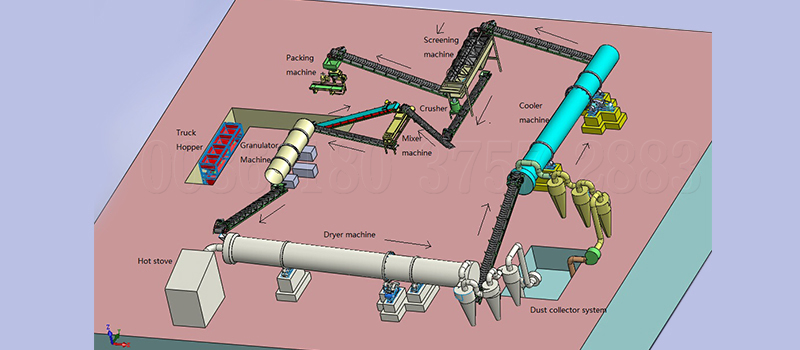
organic fertilizer granulation line

The organic fertilizer production process is closely related to the equipment configuration of the organic fertilizer production line. General organic fertilizer production line complete equipment is mainly composed of fermentation system, drying system, deodorization and dust removal system, crushing system, batching system, mixing system, granulation system, screening system and finished product packaging system.

The construction scale of the equipment configuration of the granular duck manure organic fertilizer production line is generally 5,000 tons-100,000 tons per year. It is necessary to comprehensively consider local resources, market capacity, and market coverage.

The investment scale and product plan design of the granular duck manure organic fertilizer production line need to be formulated according to the following conditions: raw material resource characteristics, local soil conditions, local planting structure and main crop varieties, and comprehensive consideration of local resources, market capacity, and market coverage radius.

The investment scale and product plan design of the granular duck manure organic fertilizer production line need to be formulated according to the characteristics of raw material resources, local soil conditions, local planting structure and main crop varieties, factory site conditions, and the degree of automation of production. FPC has a full set of granular duck manure organic fertilizer production line configuration, professional engineers design a variety of configuration schemes for you.
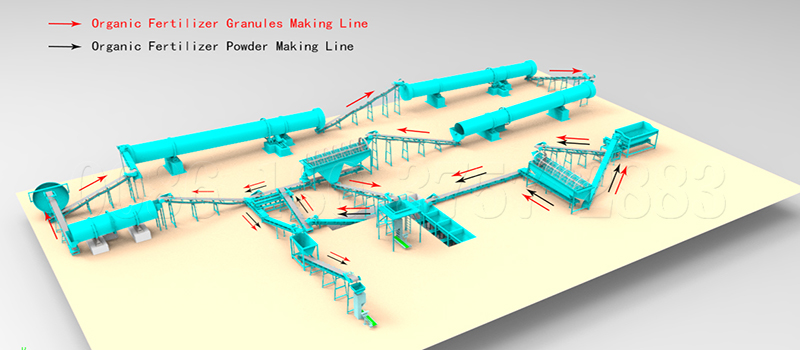
How Should the Organic Fertilizer Production Line Be Equipped?

The construction of the organic fertilizer production line is related to many aspects. Manufacturers often encounter many problems when building organic fertilizer production lines. I don’t know how to choose the machines needed in each link and how to produce organic fertilizer with high quality and high price. Let me explain to you how to build an organic fertilizer production line correctly.

Generally speaking, the production of organic fertilizer can be divided into four major steps: fermentation-crushing-granulation-drying-packaging. These necessary steps also have more extended procedures, such as stirring, cooling, screening, and coating.

How the customer chooses an organic fertilizer production line often depends on the raw materials needed to make organic fertilizer. For example, in the crushing process, different crushers are selected according to the water content of the raw materials. Usually, we should use a semi-wet material pulverizer to crush the raw materials with higher water content. If it is dry material, such as dry cow dung and sheep dung, we can use a vertical grinder to crush it. In the granulation process, we recommend different types of granulators according to the fiber size of the raw materials. We usually use discs or drum granulators for finer fiber raw materials, such as chicken manure. The coarser fiber materials use flat film extrusion granulator, such as cow dung, straw and so on. In the drying process, if the budget is sufficient, we often recommend that customers install a cooler after the drying process, which is mainly to prevent the agglomeration caused by overheating of the particles. In the later stage of granulation, there are also optional processes such as coating and polishing. These are all procedures for “beauty” for the finished product, making the granules more beautiful, neat and attractive.

Fermentation Method of Manure Organic Fertilizer Production Line

Fermented livestock manure is a high-quality organic fertilizer with rich nutrient content. There are both a large amount of organic matter and a high content of three essential nutrients. Organic matter contains 25.5% of stars, 1.63% of nitrogen, 1.54% of phosphorus, and 0.35% of potassium. Manure does not decompose and is applied directly to crops:

  1. Infect pests. Stool contains E. coli and square nematode.
  2. Destroy crops. After the unfermented raw manure and other organic materials are applied to the ground, when the fermentation conditions are available, they are fermented under biological activities. When the fermented part is close to the root and the crop plant is small, the heat generated by the fermentation will affect the growth of the crop , Burn the roots of crops.
  3. Odor. During the decomposition process, gases such as methane and ammonia are produced, which make the soil and crops produce acid and damage the roots of crops.

What is the effect of fermented organic fertilizer (take chicken manure as an example):

  1. Produce a variety of enzymes to control stubble and root-knot nematodes.
  2. Contains beneficial microbial flora, which can activate nitrogen in the air, release phosphorus and potassium nutrients, and replenish soil organic matter.
  3. The soil is soft and easy to cultivate, which promotes soil aggregate structure, releases soil pores, and promotes the growth of roots. Make the soil retain water and fertilizer.

Self Propelled Windrow Compost Turner For Sale

Fermentation method of manure organic fertilizer production line:

The enzymatic process is divided into: composting, heating, turning and throwing, odorless, loose, and fertilizer. When composting, 80% of livestock manure and 20% of straw are crushed and mixed. The mixing ratio of straw and feces can be determined according to the moisture content of the feces. Generally, fermentation requires 65% water content, that is, the hands are kneaded into a ball, water sees through the fingers, but does not drip, and it will dissolve as soon as you let go. Then add corn flour or brown sugar and bacteria to increase the sugar content for the fermentation of the bacteria, so that the multi-dimensional complex enzyme bacteria has an absolute advantage. Add the prepared mixture to the mixer for mixing, mixing-it must be even and thorough without leaving any lumps.

The mixed ingredients are piled into strips with a width of 1.5 meters to 2 meters, a height of 0.8 meters to 1.2 meters and a length of not less than 5 meters. During the fermentation process, pay attention to proper oxygen supply and turn over (turn over several times when the temperature rises to 75or above), and control the temperature rise at about 65°C. Too high temperature will affect the fermentation product.

The moisture of the fermented materials should be controlled at 60~65%. Too high or too low is not conducive to fermentation. Too little water makes fermentation slow. Too much water will cause poor ventilation, slow heating, and produce odor.

The initial temperature of fermentation is 50℃-80℃, which eliminates the odor of chicken manure and other bacteria. In the middle of fermentation and composting, the material becomes loose and dry, with white hyphae. During the fermentation maturity period, the materials give off the scent of koji, and the bacterial fertilizer will be fermented and mature.

Introduction of Granulation Process of Organic Fertilizer Production Line

In a whole set of organic fertilizer production line, granulation is a key process in the whole production process. The productivity of the organic fertilizer granulator, the strength and shape of the granules produced directly affect the quality of the product.

Rotary Drum Fertilizer Granulating Machine

Among the many organic fertilizer production enterprises, the most used organic fertilizer granulation equipment includes drum granulator, extrusion granulation machine and disk granulator machine. Among the three granulation methods, the disc granulator is more suitable for the granulation of organic-inorganic compound fertilizer, and the effect is more ideal. The disc granulator is mainly composed of granulation disc, spray system, transmission device, bracket and so on.

Pig Manure Granulation Machine

During production, the powder raw materials are conveyed by the belt conveyor to the granulation disc in the disc granulator, and the rotating disc with an inclination of 50° rotates the animal material. When the material is brought to a certain height, under the action of its own gravity and inertial force, it breaks away from the disc and slides down along the arc-shaped trajectory to complete the rolling required for granulation. At the same time, the liquid injected by the spray system will be evenly sprayed on the rolling materials to agglomerate them into granules, thus completing the entire granulation process. According to the principle applied in this granulation process, we can call it agglomerate granulation process. With the continuous addition of raw materials, the manufactured particles fall across the edge of the disk under the action of centrifugal force and fall into the belt conveying equipment below.

Double Roller Powder Granulator

As an old model, the disc granulator has experienced the test of various materials, but any equipment has advantages and disadvantages. With the diversification of raw materials, organic fertilizer equipment manufacturers are constantly developing new granulation equipment. In the production of ordinary organic fertilizers, there is a new type fertilizer stirring tooth granulator, which has high production efficiency and good product quality. In terms of organic-inorganic compound fertilizer, there is also a new type compound fertilizer granulator, which is improved on the basis of the stirring tooth granulator, but it has solved the problem of material sticking to the wall. It’s also very beautiful. The diversification of raw materials has promoted the diversification of organic fertilizer granulation equipment. Only by purchasing equipment suitable for your own materials can the whole set of organic fertilizer equipment be effective.

It is Important to Add Moisture When Producing Organic Fertilizer Granulator

The organic fertilizer granulator requires materials and moisture during the production process. How to add water for good pellet production, how to make the granulator faster and more efficient, the proportion of water added is very important. Next, let me talk about the addition of water to the granulator.

fertilizer rotary drum granulator

In the production process of organic fertilizer granulator, the material is required to have viscosity. Some raw materials are relatively loose after fermentation and it is not easy to pelletize. Some water or binders must be added to increase the viscosity of the materials. The organic fertilizer equipment disc granulator and the rotary drum type fertilizer granulator adopt agglomeration granulation method. During the granulation process, water or binder is added to ensure that the material can be granulated smoothly. The new organic fertilizer granulator adopts wet granulation, and the materials after fermentation can be directly granulated without other processes. The double roll press pelletizer is produced by a non-drying room temperature process, which is suitable for granulating materials with relatively low viscosity or relatively low water content.

Pig Manure Granulation Machine

If the water content of the material is too high, you can add some relatively dry materials in an appropriate amount to neutralize the water content. If the water content is too low, add water in an appropriate amount to facilitate granulation.

Double Roller Powder Granulator

The new organic fertilizer granulator is an organic fertilizer granulating equipment that continues to be updated and reproduced with the development of agriculture, technological improvement, and diverse needs. The new organic fertilizer wet granulator can realize the selection of materials. As long as the various organic substances after effective fermentation can be granulated by the new organic fertilizer granulator, the limitations and obstacles of the traditional process are broken. Moreover, it is not necessary to stop the processing, crushing and drying tasks of the raw materials before granulation, and can directly realize the batching processing and direct granulation. It not only saves a small amount of labor input, but also realizes the effective reduction of costs, but also realizes the improvement of task efficiency, which is convenient and fast, and the effect is satisfactory. The new organic fertilizer granulator also achieves a higher organic content, realizing the exclusive manufacturing of pure organic fertilizers.

The emergence of the organic fertilizer granulator has brought a great contribution to the development of agriculture. Mastering the above knowledge can develop production more effectively.

What Is the Cause of the Clogging of the Organic Fertilizer Equipment Pulverizer?

There are a lot of grinders in our daily life, such as laboratory jet grinders, organic fertilizer grinder machines, etc., but in the process of use, sometimes there will be some failures, such as clogging of the grinder, when it is blocked , How should we deal with it? In fact, clogging is a very common failure of the shredder during smashing, and the main reason is still caused by improper operation. The editor of the organic fertilizer equipment manufacturer will teach you some methods to deal with the clogging of the grinder.

semi wet material crusher details

Reasons and solutions for the clogging of the crusher of the organic fertilizer equipment:

  1. The feeding speed is too fast and the load increases, causing blockage. During the feeding process, pay attention to the deflection angle of the ammeter pointer at any time. If it exceeds the rated current, it indicates that the motor is overloaded, and the motor will be burnt if overloaded for a long time. When this happens, the feed door should be reduced or closed immediately, or the feed mode can be changed, and the feed volume can be controlled by adding the feeder. There are two types of feeders: manual and automatic. The user should choose the appropriate feeder according to the actual situation. Due to the high speed of the crusher, the large load, and the strong fluctuation of the load. Therefore, the current of the shredder is generally controlled at about 85% of the rated current.
  2. The discharging pipeline is not smooth or blocked and the feed is too fast, which will block the tuyere of the grinder equipment, and improper matching with the conveying equipment will cause the discharge pipeline to be blocked when the wind is weakened or there is no wind. After the fault is detected, the unmatched conveying equipment should be cleared first, and the feeding amount should be adjusted to make the equipment operate normally.
  3. Hammer fragments, aging, closed or broken screen mesh, and high water content of the crushed materials will block the crusher. The broken and severely aged hammers should be updated regularly, keep the crusher in good working condition, and check the screen regularly. The moisture content of the crushed material should be less than 14%, which can improve the production efficiency of G, and prevent the pulverizer machine from clogging. , Enhance the reliability of the crusher’s work.
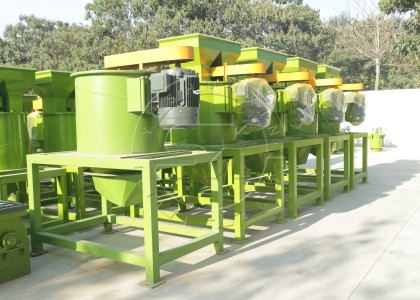
Vertical Fertilizer Material Crushing Machines

Vertical Fertilizer Material Crushing Machines

The content of the above article is the method to deal with the clogging of the crusher of the organic fertilizer processing equipment. Only by solving the problem in time can the service life of the organic fertilizer processing equipment be longer.

Introduction of FPC Trough Type Fermentation Equipment

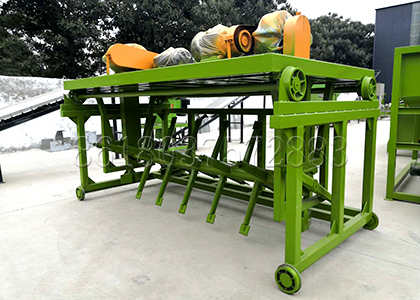
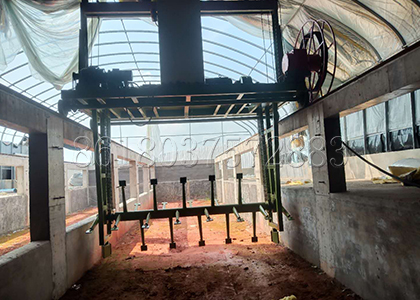
The trough type fermentation equipment mainly refers to the trough type compost turning machine. The trough compost turning machine is a kind of turning and polishing equipment matched with the fermentation tank. Rails are installed on the tops of both sides of the fermentation tank, and the turning compost machine can run back and forth on the rails. Generally, the trough-type turning machine is equipped with one machine and multiple tanks, and the transfer of the turning machine between the fermentation tanks can be realized by a moving machine. The groove type turning compost machine is mainly composed of a frame, turning and polishing device, walking mechanism, cable reel device, electric control system, etc. It is mainly driven by electric power.

Groove type compost turner

The trough fermentation system has the advantages of small footprint, high composting depth (0.8-2.5 m), fast temperature rise and large processing capacity. During the trough fermentation process, it can maintain and ensure the formation of an alternating state of medium temperature-high temperature-medium temperature-high temperature, which effectively shortens the fermentation cycle. A device for adding bacteria is installed on the turning compost machine, which can spray evenly and proportionally during the fermentation process. At the same time, a ventilation pipe can be laid at the bottom of the tank to increase ventilation. There are also groove composting equipment using electricity, no exhaust pollution, odor and water seepage can also be effectively controlled. The trough turning machine is suitable for refined and large-scale production, which is conducive to production management and production cost control.

Installed groove type compost turning machine

The trough turning composter machine can improve the safety of walking, the reliability of the turning system, the adaptability of composting materials and the degree of automation of operation. It produces products with high efficiency, stable and reliable operation, sturdy and durable, uniform turning and polishing, and is well received by the market.

What Heat Source Is Good for Organic Fertilizer Dryer Equipment?

Organic fertilizer drum drying equipment is a device that uses thermal energy to dry organic materials with high moisture content. The use of thermal energy plays an important role in the drying process. If the heat energy cannot be taken away in time or the circulation is not smooth, the whole system will be affected.

manure rotary dryer machine in organic fertilizer production line

There are many forms of thermal energy generation, such as electric heating pipes, natural gas, diesel, and coal, which can be generated by certain equipment. The heat sources of the organic fertilizer dryer equipment include electric heaters, gas burners, oil burners, coal-burning stoves, etc. Electric heating is widely used in small drying equipment, and is generally used in laboratories. It does not have any pollution problems and heats up faster. Burners are mainly used in large-scale drying equipment and play a pivotal role in industrial production.

The induced draft fan of the organic fertilizer drying equipment is controlled by a frequency converter, which has a relatively high degree of automation and saves a lot of manpower and material resources. Coal-fired hot blast stoves are also widely used as the heat source of dryers, and can be used directly in occasions where material requirements are not strict. The use of direct-fired hot air in the occasions with strict requirements on materials cannot meet the requirements, and a heat exchange device is needed to reduce the degree of pollution to the materials.

What Are the Traditional Bio-Organic Fertilizer Production Processes?

There are a wide range of sources of bio-organic fertilizer, mainly in several categories:

  1. Agricultural wastes are mainly rural straws and livestock manure. As more and more agricultural wastes are produced, they will pollute the environment if they are not handled properly.
  2. Domestic waste, such as food waste, street waste and other wastes. With the rapid development of the world economy, people’s living standards are getting better and better, and the amount of domestic waste generated is increasing day by day. Domestic waste not only pollutes the surrounding area and affects the living environment, but also spreads diseases, becoming a problem that cannot be ignored in hindering urban development.
  3. Municipal sludge. With the development of cities, the number and scale of sewage treatment plants continue to grow, resulting in a large amount of sludge. In order to protect the environment and utilize resources, the disposal and utilization of sludge is an issue that should arouse widespread attention. Sewage sludge is very valuable as a source of plant nutrients, soil organic matter, alkaline stabilizing materials, and lime agents.

Cow maure bio organic fertilizer granulation line

Bio-organic fertilizer process, the traditional bio-organic fertilizer production process mainly adopts two fermentation methods: compost fermentation and aerobic ventilation fermentation. Composting is the use of microorganisms to mineralize and humify agricultural wastes, household garbage, sludge and other materials, and eventually become decomposed fertilizers. The traditional composting method has slow decomposition of organic matter and long fermentation time, and it is easy to produce malodorous gas during the composting process, and the fertilizer efficiency of the product is low. Aerobic fermentation mainly uses aerobic bacteria to degrade organic wastes and compost them to maturity. Aerobic fermentation mainly uses aerobic bacteria to degrade organic wastes and compost them to maturity. The gas produced in the process of aerobic fermentation is directly discharged into the air, causing pollution to the atmosphere, and at the same time, some organic fertilizer nutrients will be lost with the steam.

With the advancement of science and technology, the production technology of bio-organic fertilizer has been continuously improved. The core of the research on the improvement of bio-organic fertilizer production is the development of fermentation inoculants. The microbial activity in the fermentation process is the key to the performance of the fertilizer. By adding microbial agents with specific functions to the fermentation process, the humification efficiency is improved, the quality of the product fertilizer is improved, and the fermentation time can be shortened, and the production cost can be reduced. The application of bio-organic fertilizer meets the requirements of environmental protection and energy saving. With the improvement of people’s living standards, people’s demand for green organic food is increasing. Therefore, the application prospect of bio-organic fertilizer is very broad.

How to Use Animal Manure to Produce Round Granular Organic Fertilizer?

The process steps of using livestock manure to make round granular organic fertilizer:

Step 1: Fermentation is mature. Collect the liquid of livestock and poultry manure, mix it with straw, hay, etc. to control the water content of about 65%, and then transport it to the fermentation tank, sprinkle with aerobic fermentation bacteria, and use a hydraulic trough turning machine to fully mix it and let it In the fermentation process, a pile turning machine is used to turn the material into a pile and cool down during the fermentation process.

crawler type compost turner machine

Step 2: Material crushing. The materials decomposed through high temperature are processed by organic fertilizer crusher equipment. The organic fertilizer wet material crusher is a professional crushing equipment for crushing high humidity and multi-fiber materials. The high-speed rotating chain is used to crush the fiber with a good particle size.

semi wet material crusher details

Step 3: Mix and stir. Add trace elements, auxiliary materials, humic acid, clay, etc. to mix and stir. The vertical mixer has a fast mixing speed and good uniformity. It can mix and add 30% viscous materials with liquid. When working, there are two oppositely rotating blades and rotors that are stirred in the middle. The bottom opening door is adopted for fast unloading speed and less residual quantity.

mixng machine

Step 4: Forming and granulating. Use organic fertilizer disc granulator, organic fertilizer stirring teeth pelletizer or new type gear drum three-combination granulator to granulate the material.

Pig Manure Granulation Machine

Step 5: Tumble drying. The organic fertilizer dryer further removes water from the granulated particles to meet the standard requirements of organic fertilizer moisture content.

manure rotary dryer machine in organic fertilizer production line

Step 6: Drum cooling. Use a cooler to cool the dried granular material, which is helpful for the storage and quality of the granules.

Step 7: Screening and material return system. Due to the granular material output by the granulation molding system, the particle size has a certain difference, which needs to be sieved and classified. The selected drum screening machine requires low vibration, low noise, convenient screen change, and is equipped with a screen surface cleaning device.

Customized Fertilizer Screening Machine in ShunXin

Step 8: Particle coating equipment. The coating machine is composed of a screw conveyor, a stirring tank, an oil pump, a main engine, etc., with a powder coating or liquid coating process. It can effectively prevent the agglomeration of fertilizers. The main machine adopts polypropylene lining or acid-resistant stainless steel.

fertilizer granules coating machine

Step 9: Pack the equipment. The granular material is packaged and enters the finished product warehouse through the conveying equipment. Granular materials can be quantitatively weighed and packaged through automatic packaging scales.

single bucket powder fertilizer automatic packing machine