My Blog

My WordPress Blog

Month: November 2021

How to Deal with Cow Dung on Small Cattle Farms?

We all know that beef is a good thing. It not only tastes good but also contains rich nutrients. It also sells well in the agricultural market. But what can everyone know about the cow dung produced by cows? Cow dung is also a valuable resource brought to us by cows. If cow dung is mixed with crop straw, mushroom residue, sawdust and other paving materials in a certain proportion (dung accounting for 80-90%) , The others account for 10-20%), and then the raw materials for making cow manure organic fertilizer can be produced after fermentation. The specific situation will be explained by FPC.

The cow dung organic fertilizer equipment is a whole production line developed by the FPC company after more than 15 years of technological precipitation and technological reform. The specific conditions of the raw materials of cow dung organic fertilizer are as follows:

Wheel type Compost Turner for Large Scale Composting

1) Control of the moisture content of cow manure organic fertilizer raw materials: when fermenting cow manure, the moisture control content should be 40%-65%. The method of judging is to hold a handful of materials tightly, the best condition is that the materials do not drip when they see water between the fingers, and the materials will disperse when they fall on the ground. During the fermentation period, less water will lead to slow fermentation, and more water will affect the ventilation of the material, so we must control the moisture.

2) Control of fermentation temperature of cow manure organic fertilizer: the initial temperature of cow manure organic fertilizer raw material fermentation can be controlled above 15 ℃, which is more appropriate (operable in four seasons, not affected by the season, try to ferment indoors or in a greenhouse in winter). The fermentation temperature should be controlled below 70-75℃.

Self Propelled Windrow Compost Turner For Sale

3) Oxygen supply measures for cow manure organic fertilizer: During the fermentation of organic fertilizer raw materials, cow manure requires aerobic fermentation. Therefore, we need 2-3 days to use turning equipment for turning during fermentation (turning equipment: trough composting turner machine, mobile compost turning machine) in order to achieve the purpose of oxygen supply. If this situation is not taken seriously, it is likely to cause anaerobic fermentation and produce odor, which will affect the effect of fertilizer.

4) Fermentation time of cow dung raw materials: The fermentation of cow dung organic fertilizer raw materials is generally stacked for 48 hours, and the temperature rises to 50-60 ℃, and can reach 65 ℃ or more on the third day, and the fermentation of the whole raw material is completed within 15-30 days. When the material is dark brown and white mycelium appears on the surface, it indicates that the fermentation has been completed.

Moving type compost turning machie

The above is the fermentation process of cow manure organic fertilizer raw materials, and the complete set of small-scale cow manure organic fertilizer production line equipment is generally within $30,000-$90,000. Since all our equipment can be customized, each customer’s needs are different and the customized organic fertilizer production line is also different. Therefore, the price of a complete set of cow manure organic fertilizer equipment ranges from tens of thousands of dollars to hundreds of thousands of dollars. The main configuration principle is set according to the customer’s site selection and the personal capital chain supply situation.

Classification and Difference of Organic Fertilizer Granulator

The organic fertilizer granulator is the main mechanical facility for granulating the fermented organic fertilizer. There are also a wide variety of organic fertilizer granulators. The well-known ones are extrusion granulators, disc granulators, drum granulators, roller extrusion granulators, flat film granulators, and so on. So how do we distinguish them in our work?

Rotary Drum Fertilizer Granulating Machine

The drum granulator is suitable for organic and inorganic materials. In addition, the equipment is easy to operate, flexible in work, and convenient to maintain.

The disc granulator relies on water spray to granulate, because the granulation rate can reach more than 93%. The pelletizing tray is equipped with three discharge ports, which is convenient for intermittent production operations, greatly reduces labor intensity and improves labor efficiency.

Double Rolloer Granulator for NPK Compound Fertilizer Plant

Double Rolloer Granulator for NPK Compound Fertilizer Plant

The particles of the extrusion granulator can be directly bagged. The extrusion granulator is also suitable for metallurgical material particles, refractory material particles, and mineral powder particles. There is no need to add drying equipment when designing an organic fertilizer production line. The investment of the extrusion granulator is small, and the effect is quick, with an annual output of 10,000 to 100,000 tons.

New Developed Goat Manure Compost Pellet Machine

The roller extrusion granulator is a granulating equipment. It is produced by the non-drying process, one-time molding, and the output is 1-1.5 tons/hour and 1.5-3 tons/hour. The organic fertilizer granulator has low investment, quick effect and good economic benefits.

Although there are many types of organic fertilizer granulators, each has its own unique function, and the output will increase if combined with supporting production. After everyone understands these differences, there should be some changes in the use of organic fertilizer granulators.

What Are the Advantages of Organic Fertilizer Produced by Organic Fertilizer Equipment Compared with Other Fertilizers?

With the development of agricultural technology, earth-shaking changes have taken place in the fertilizer industry. The use of traditional fertilizers has been gradually reduced. Now the majority of farmers prefer organic fertilizers produced by organic fertilizer equipment. So what are the advantages of organic fertilizers to allow farmers Do friends love it so much?

Wheel type Compost Turner for Large Scale Composting

The organic fertilizer fermented by the organic fertilizer equipment improves the soil and is good for absorption: it is rich in organic matter and humus, improves the nitrogen fixation capacity of phosphate fertilizer, melts water, promotes the absorption of plants, and increases the activity of beneficial microorganisms in the soil, thereby producing biological regulation substances that can stimulate Root growth promotes nutrient absorption and effectively improves nutrient absorption and utilization.

The chicken manure treated by the organic fertilizer equipment can maintain a good soil aggregate structure after being applied to the soil. The biological activity of the organic matter promotes the activity of various enzymes in the body and accelerates the growth of crops. According to its beneficial advantages, it can inhibit the formation, reduce the production of viruses, reduce the occurrence of diseases, and improve plant activity.

Self Propelled Windrow Compost Turner For Sale

The organic fertilizer produced by the fermentation process of the organic fertilizer equipment can activate the soil, improve soil compaction, nutrient loss, improve soil permeability and plow layer, loosen the soil, increase soil moisture, reduce nutrient absorption resistance, and promote nutrients to crop roots International transfer, enhanced drought resistance, low investment, high output, and remarkable results.

It is precisely because the effect of organic fertilizer produced by organic fertilizer equipment is so good that it can reduce pests and diseases and increase crop yields, so it is deeply loved by farmers. This is why it can replace traditional fertilizers.

Two Methods of Making Bio-Organic Fertilizer Using Bio-Organic Fertilizer Equipment

With strip or trough compost, the compost temperature can rise to about 50℃. Within 48 hours, the stack temperature can rise above 60°C, or even as high as 70°C. Such a temperature in spring, summer, and autumn can make all the raw materials in the pile decompose in 5-7 days, the odor disappears, and all the pathogenic bacteria, insect eggs, and grass seeds in the raw materials are killed. Fertilizer fermented by this method can be called ecological organic fertilizer or pollution-free organic fertilizer, which can be directly used on crops.

Bio Organic Fertilizer Production Process Flow Chart

Two methods and production processes for making bio-organic fertilizer using bio-organic fertilizer equipment

There are two common production methods for bio-organic fertilizer, namely, mixed fermentation of manure straw and fermentation of livestock and poultry manure. The equipment for making bio-organic fertilizer includes composter equipment, crushing equipment, mixing equipment, granular equipment and so on.

  1. Use livestock manure and crop straws and other wastes to mix and ferment organic fertilizer. When using crop straw and other raw materials for fermentation, about 20% of livestock manure can be added, and when using livestock and poultry manure as the main raw material, about 20% of straw powder can be added. The fermentation method is the same as described above.

If fermented with more acidic raw materials, 1-3% lime powder should be added during fermentation to adjust the pH to neutral. The organic fertilizer fermented by this method is suitable for various crops and various soils.

  1. Use livestock manure to ferment organic fertilizer. Use chicken manure, pig manure, sheep manure and other livestock manure as raw materials. The water content is controlled at about 40%, and it contains about 1.6 tons of raw materials + 5 kg of probiotic liquid + 2-3 kg of corn flour mixed and mixed and crushed.

What Conditions Are Needed to Build a Small Organic Fertilizer Production Line?

The small scale organic fertilizer equipment production line can be either a powdery organic fertilizer production process line or a granular organic fertilizer production process line. Among them, the powdery organic fertilizer process line is a component of the granular organic fertilizer process line. Generally speaking, organic fertilizer production lines with an annual output of 20,000 tons (including) and organic fertilizer equipment production lines with an annual output of less than 20,000 tons are all small-scale organic fertilizer production lines. According to the plans of most customers, the small-scale organic fertilizer production line basically has several major production lines with main production capacities of 5,000 tons, 10,000 tons, 15,000 tons, and 20,000 tons.

Granular and powder organic fertilizer production line

Since the powdery organic fertilizer equipment production line is a component of the granular organic fertilizer production line, today we will use the granular organic fertilizer production line to elaborate on the small scale organic fertilizer production line process. Know the process of the powdery organic fertilizer production line.

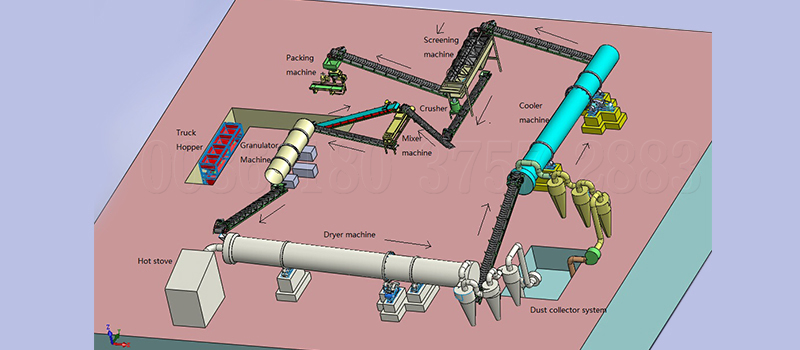
According to the process stage, the granular organic fertilizer production line is divided into ① crushing process; ② fermentation process; ③ stirring and mixing process; ④ granulation process; ⑤ drying process; ⑥ screening process; ⑦ coating process; ⑧ packaging process.

The process flow of powdered organic fertilizer includes the above-mentioned ① crushing process; ② fermentation process; ⑧ packaging process.

So, what conditions are needed to build a small-scale organic fertilizer equipment production line?

complete organic fertilizer production line

① The construction of small-scale organic fertilizer production lines must meet the requirements of environmental protection policies. Environmental protection is not only the aspiration of the people, but also the policy needs of the development of agriculture and animal husbandry for environmental protection;

②The source of raw materials, the radius around the source of raw materials, determine your plant location, site investment, transportation investment, etc.;

③The type of raw materials, the type determines the detailed equipment used in each process stage, which affects the equipment investment price, etc.;

④The production scale, the annual output of the small organic fertilizer production line from 3,000 tons to 20,000 tons, determines the capacity requirements of the equipment, which affects the price, etc.;

⑤Recycling of resources mainly relies on the recycling and utilization of various agricultural wastes, such as first making fuel and electric energy raw materials, and using the biogas residue as organic fertilizer raw materials;

⑥Other uses of the small-scale organic fertilizer equipment production line process can be used as feed, etc.;

⑦Building site: It is necessary to determine the production site size and site size investment according to the planned production scale.

How to Distinguish the Size and Investment Cost of Organic Fertilizer Equipment?

What are the large-scale organic fertilizer equipment? The so-called large-scale organic fertilizer production equipment generally refers to organic fertilizer equipment with a large production scale and relatively high investment cost, and can also be called a large-scale organic fertilizer production line. Due to the small production scale of the small-scale organic fertilizer production line, manual auxiliary operations are required in many links, and it is difficult to complete the processing and large-scale production of a large number of raw materials. There are more and more large-scale concentrated breeding areas, which will inevitably cause small-scale organic fertilizer production enterprises to gradually shift to large and medium-sized organic fertilizer production enterprises, and the construction of large-scale organic fertilizer equipment and production lines has also become an inevitable choice. Today, I will talk to you about the topic of large-scale organic fertilizer production equipment.

Granular and powder organic fertilizer production line

First, let’s understand how to distinguish the size of the organic fertilizer equipment and the investment cost

  1. According to the output, the production of 1 ton of organic fertilizer per hour is a small-scale organic fertilizer production equipment (small-scale organic fertilizer production line), and the price is generally between 30,000-60,000 dollars, which can meet the needs of families and small farms.
  2. According to the output, the production of about 5 tons of organic fertilizer per hour is a medium-sized organic fertilizer production equipment (medium-sized organic fertilizer production line), which is the best medium-sized organic fertilizer production equipment in the market and customer evaluations, and it is also in large market demand. The investment price Generally between 60,000-100,000 dollars.
  3. According to the output, the production of more than 10 tons of organic fertilizer per hour is a large-scale organic fertilizer production equipment (large-scale organic fertilizer production line), which is an essential equipment for large-scale organic fertilizer production and processing enterprises, and is generally used in large-scale fertilizer processing enterprises. The investment price is more than $100,000.

The Difference Between Powdery Organic Fertilizer Equipment and Granular Organic Fertilizer Equipment

As the process part of the granular organic fertilizer production equipment, the main technical means of the powdered organic fertilizer equipment are: fermentation, decomposition, crushing and mixing of organic raw materials, livestock and poultry manure or domestic garbage, sludge, distiller’s grains, biogas residue and other raw materials ,Package.

The basic process configuration of organic fertilizer equipment is dehydration, drying, fermentation, crushing, mixing, and packaging. This completes the processing of powdered organic fertilizer. Compared with the simple process of powdered fertilizers, granular organic fertilizers require further processing.

The basic process configuration of granular organic fertilizer equipment is dehydration, drying, fermentation, crushing, stirring, granulation, cooling, and packaging. Equipped with organic fertilizer granulator, organic fertilizer dryer, organic fertilizer coating machine. After the pellets are mechanically cooled, they can be packaged, stored or sold.

Organic Fertilizer Production Line Flow Chart

Process system equipment of organic fertilizer production process flow

  1. Fermentation system: The fermentation system of the organic fertilizer equipment process is composed of a feed conveyor, a biological deodorizer, a stirring mixer, a special lifting dump truck and an electrical automatic control system.
  2. Drying system: The main equipment includes belt conveyor, rotary dryer, cooler, induced draft fan, hot air stove, etc.
  3. Deodorization and dust removal system: consists of a sedimentation chamber, a dust removal chamber, etc.
  4. Crushing system: including a new type of semi-wet material crusher, LP chain crusher or cage crusher, etc.
  5. The batching system is composed of an electronic batching system, a disc feeder, and a vibrating screen. It can be equipped with 6-8 kinds of raw materials at a time.
  6. The mixing system consists of optional horizontal mixer or pan mixer, vibrating screen, mobile belt conveyor, etc.
  7. Granulation equipment required for organic fertilizer granulation system. Optional granulation equipment includes: organic fertilizer compound fertilizer combined granulator, drum extrusion granulator, disc granulator, special granulator for organic fertilizer, rounding machine, etc.
  8. Drying system: The organic fertilizer drying system consists of a drum dryer and a cooler.
  9. Screening and coating system: It is mainly completed by a drum screening machine, which can be equipped with a one-stage screening machine and a two-stage screening machine, with high yield and good granularity; after the screening machine, coating can be used to prevent the fertility from being dispersed.
  10. The finished product packaging system generally includes electronic quantitative packaging scales, silos, automatic sewing machines, etc., to realize the automatic non-intermittent production of organic fertilizer equipment, and the conveying system mostly uses belt conveyors and screw conveyors.

Introduction of Common Production Equipment for Organic Fertilizer Production

Self Propelled Windrow Compost Turner For Sale

  • Manure compost turner machine: industrialized fermentation treatment of organic solids such as animal manure, domestic garbage, sludge, and crop straws. The equipment fully ferments the uniformity of fermented materials. So that the front of the fermentation tank can be freely put in or taken out of the fermentation method, and wastes such as feces can be retained for a long time.

high moisture materials cruhser effect

  • The wet material crusher is a professional crushing equipment for crushing high humidity and multi-fiber materials. Using high-speed rotating blades, crushed fibers have good particle size, high efficiency and high energy. The semi-wet material crusher is mostly used in the production and processing of organic fertilizer, and it has a good effect on crushing raw materials such as chicken manure and sodium humate.

mixng machine

  • The mixer has fast mixing speed and good uniformity. It can mix and add 30% viscous materials with liquid. There are two oppositely rotating paddles and rotors when it is working. Because the blade has multiple special angles, it can be mixed quickly and effectively regardless of the shape, size and density of the material. The bottom opening door is adopted for fast unloading speed and less residual quantity.

Pig Manure Granulation Machine

Chicken Manure Dryer

  • Rotary dryer is mainly composed of rotating body, lifting plate, transmission device, supporting device and sealing ring. Diameter: φ1000-φ4000, length depends on drying requirements. One of the traditional drying equipment is a cylinder that is slightly inclined to the horizontal. The material is added from the higher end, and the high temperature and hot flue gas flows into the cylinder side by side with the material. As the cylinder rotates, the material is due to gravity. Run to the lower end. A copy board is installed on the inner wall of the cylinder to pick up and sprinkle materials. In the process of falling, the material is broken into fine particles by the dispersing device, which increases the contact surface between the material and the airflow, so as to increase the drying rate and promote the advancement of the material. The dried product is collected from the lower part of the bottom end.
  • The rotary cooler can reduce the moisture content while cooling to a certain temperature, reduce labor intensity, and increase output. The drum type cooler is driven by the main motor to drive the belt and pulley, which are transmitted to the driving shaft through the reducer, and installed on the driving shaft. The split gears on the upper gear mesh with the large ring gear fixed on the body and work in opposite directions.

Customized Fertilizer Screening Machine in ShunXin

  • The drum screening machine adopts a combined screen, which is convenient for maintenance and replacement. The machine has a simple structure, convenient operation and stable operation. The drum screening machine is mainly used to separate the finished product and the returned material, and can also realize the classification of the finished product, so that the finished product is evenly classified.

fertilizer granules coating machine

  • The granular fertilizer coating machine is composed of screw conveyor, mixing tank, oil pump, main engine, etc., with powder dusting or liquid coating process, which can effectively prevent the agglomeration of compound fertilizer. The main machine adopts polypropylene lining or acid-resistant stainless steel.

fertilizer single bucket packing machine

  • The fertilizer packaging machine is mainly composed of material import, feeding mechanism (gate), weighing hopper, bag clamping mechanism, frame, suction port, pneumatic system, sensor, control box, conveying and sewing mechanism, etc.
  • Conveyor: Configure belt conveyor, bucket elevator or screw conveyor according to the actual needs of customers.

What Are the Options for Organic Fertilizer Mixer?

There are also many types of mixers. For different materials and industries, different types have different performances, and the mixing process will also be very different, as well as the effect on the finished product. Today, I will introduce the working principles of various forms of mixers.

single shaft organic fertilizer mixing machine

Single shaft horizontal mixer

This type of mixer is a batch type discharging, and its feeding and discharging system is carried out in a certain cycle cycle. The material enters the mixing chamber, and the unloading system is turned on to discharge the material after being fully stirred and mixed. The continuous discharging is the simultaneous mixing operation of the material from the feeding port to the discharging port. Therefore, in terms of the mixing quality, the mixing quality of the batch mixer is better than that of the continuous mixer.

In the process of mixing and mixing materials, in order to obtain better mixing and mixing effects and save energy. It is required that the materials cannot be thrown up in series during the mixing and stirring of the materials. Because the movement of the material is affected by the rotating spiral blade, the movement of the material is not simply along the edge.

It moves linearly along the spiral axis, but moves back and forth in space along the spiral axis. The material is affected by the friction between the spiral blades and the friction between the materials.

In the whole mixing and stirring process, when the spiral speed exceeds a certain speed, the material will jump in the direction perpendicular to the axial direction due to excessive centrifugal force. The weakening of the axial thrust will affect the convection of the material, thereby reducing the uniformity of the material mixing.

double shaft mixing machine

Double shaft mixer

Compared with the single-shaft horizontal mixer, the double-shaft organic fertilizer mixer is a continuous discharge. It is suitable for use in mass production. Because the single-shaft horizontal mixer cannot provide enough mixing materials for production due to the limitation of its own volume and the limitation of mixing time, the double-shaft mixer that can continuously discharge the material plays a great role in this case.

Similar to the double-shaft screw conveyor, the two horizontally arranged augers inside the machine are the main working parts of the mixer. The motor transmits power through the auger shaft to drive the auger blades to rotate, and the auger blades are fixed on the auger shaft by a screw rod. , Its angle can be adjusted according to production needs to control its discharging speed and mixing quality. The centering design of the spiral blades of the double auger realizes multi-directional circulation such as axial horizontal stirring and circular movement of the material. The mixing mode includes a variety of mixing processes.

The two counter-rotating auger shafts drive the blades to rotate relative to each other, so that the mixture can realize tangential and axial compound movements. The stirring device enables the components of the mixture to be sheared, kneaded and evenly mixed. The discharged materials are all in the form of granules or powders. They are adhesive materials with good scattering properties and are beneficial to the later granulation.

vertical type mixing machine

Vertical mixer machine

Different from the cylindrical gear reducer used in the horizontal mixer, the reducer of the vertical organic fertilizer mixer adopts a vertical cycloid reducer. The mixing chamber is a low cylindrical structure, and the materials are spread in a thin layer. Therefore, the required power is not very large, and it is more suitable for mixing fertilizer raw materials.

Because the fertilizer raw materials are easy to absorb moisture and have a certain viscosity, they are easy to stick to the wall of the pan during production, forming a dense material bonding layer, resulting in high internal friction of the machine and making the blending mixer bear excessive load. In order to avoid causing the motor overload to affect production, movable protective nets are installed at the feeding ports. On the one hand, it prevents too much material from entering the mixer, on the other hand, it is used as a safety protection measure to prevent accidents during operation.

The inside of the silo can also be lined with plastic plates to reduce material adhesion and friction, and it is not easy to cause corrosion of the disk body, which extends the service life of the whole machine.

What Is the Function of Organic Fertilizer Production Line Equipment?

The production line of organic fertilizer not only effectively solves the environmental pollution caused by organic wastes in livestock and poultry breeding, but also reduces the eutrophication of surface waters caused by pollution. It is also conducive to improving the safety and quality of agricultural products and providing green food and food for humans. Organic food has laid a good foundation, and the ecological and environmental benefits are extremely significant.

The raw materials of organic fertilizer come from livestock manure, animal and plant residues or agricultural production wastes, and contain a large amount of organic matter, which can provide comprehensive nutrition for crops. The organic fertilizer production line is a special processing equipment for organic fertilizer, which is widely used in agricultural development and has gradually become an indispensable machine for agricultural development.

Organic Fertilizer Production Line Flow Chart

The organic fertilizer produced by organic fertilizer production line can improve the soil, increase organic matter, and have good fertilizer efficiency. Not only can it increase soil organic matter and improve soil physical and chemical properties, but it can also be used as feed to return to the field. To improve the poor soil physical and chemical properties, the soil nutrient content is low, the nutrient is unbalanced, and the water, air, and heat conditions in the soil are not coordinated, and the soil biological condition is poor.

Powdery organic fertilizer production line

The organic fertilizer production line has realized the circular development of agricultural resources, not only solving environmental pollution, but also turning waste into treasure by using renewable resources. The organic fertilizer production line technology gradually promotes the combined use of decomposed substances and chemical fertilizers in a planned way, with decomposed substances as the mainstay, and chemical fertilizers as the supplement. Then slowly reduce the amount of chemical fertilizers and increase the amount of decomposed substances. In the end, the effect of using only decomposed substances and using no or as little chemical fertilizer as possible is achieved. The bio-organic fertilizer production line realizes true circular agriculture and green agriculture.